






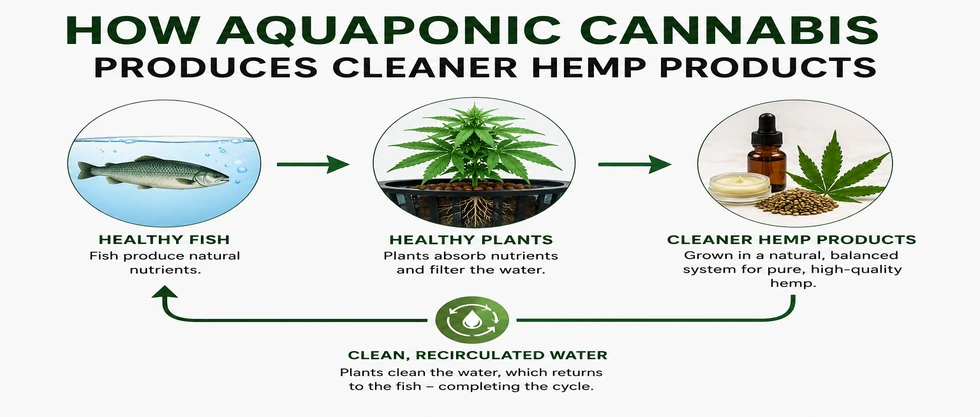
What if the cleanest part of a hemp product begins with fish?
Long before extraction, formulation, or packaging, hemp quality is shaped by its water, nutrients, growing environment, and pest control methods. Aquaponic cannabis places those factors inside a closely managed ecosystem where fish, beneficial bacteria, and plants support one another.
The method can reduce exposure to several contamination routes linked to field soil, runoff, conventional fertilisers, and routine pesticide use. Still, aquaponic hemp is not automatically organic, pesticide-free, or free from contaminants.
So, can aquaponics produce noticeably cleaner hemp products, or does it simply give growers tighter control? The difference becomes clear once you follow the water.
What Is Aquaponic Cannabis?
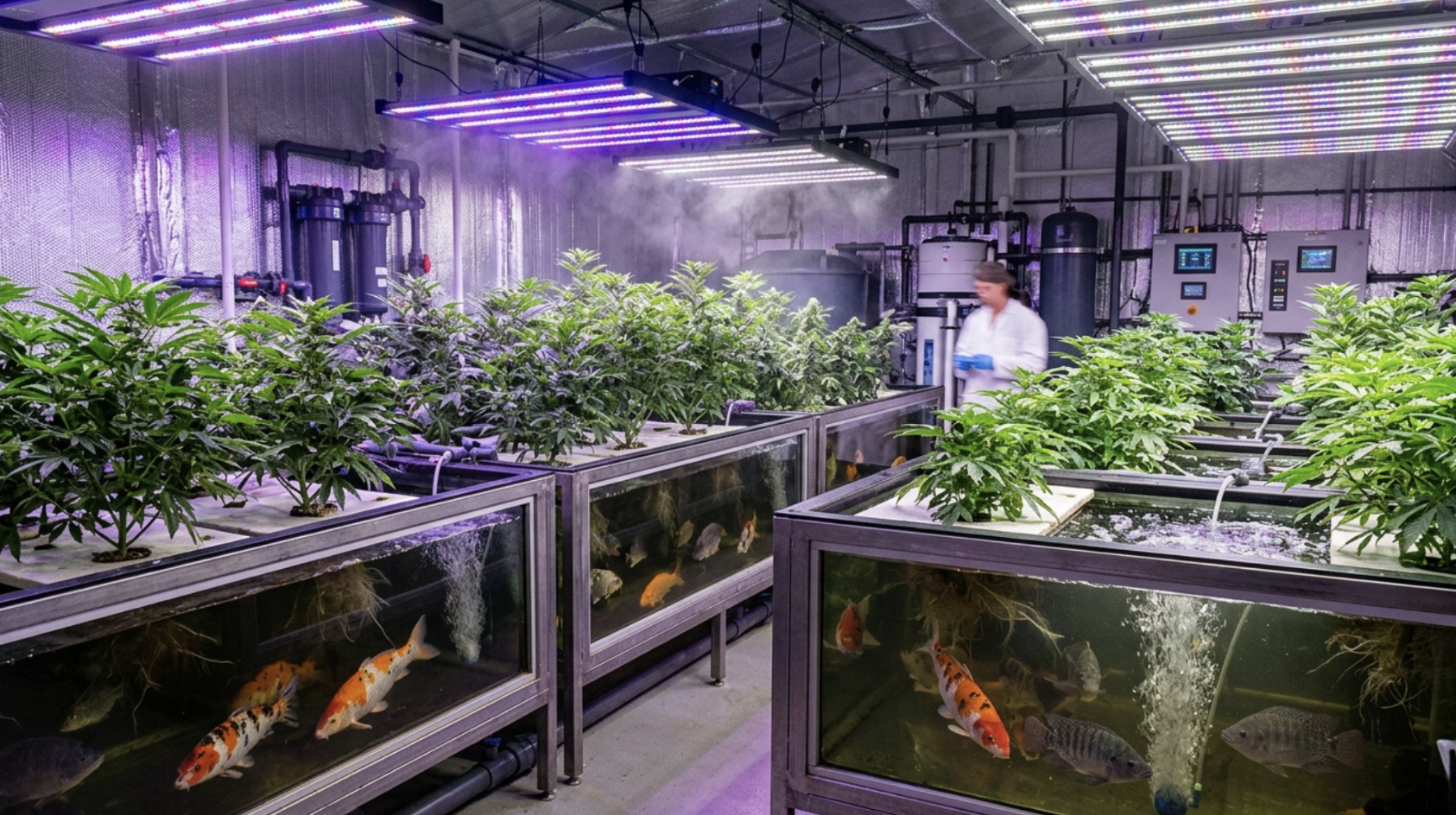
Aquaponic cannabis is hemp or cannabis grown in a managed system that connects fish production with plant cultivation. Instead of relying only on manufactured fertilisers, growers use nutrients recovered from aquaculture water to support the crop.
The cycle involves more than sending dirty fish water to plant roots:
- Fish consume feed and release ammonia-rich waste.
- Beneficial microorganisms convert ammonia into nitrite, then nitrate.
- Hemp roots absorb nitrate and other available minerals.
- Pumps move water through filters, growing areas, or separate treatment loops.
Solid waste does not simply become instant plant food. Mechanical filters remove it, or growers mineralise it, so additional nutrients become available. A working setup may include fish tanks, biofilters, pumps, aeration equipment, plant beds, and water monitoring devices.
Coupled systems circulate water between fish and plants, while decoupled designs separate parts of the flow. Ounce of Hope describes its approach as decoupled aquaponics paired with living soil raised beds.
What Does “Cleaner Hemp” Actually Mean?
“Cleaner” sounds reassuring, but the word means little unless a producer can show what was reduced, measured, or verified.
For hemp, the claim usually points to three different ideas:
- Reduced exposure to unwanted inputs during cultivation
• Lower contaminant levels in harvested biomass or finished products
• Less environmental impact from water use, waste, energy, or discharge
These qualities can overlap, but they are not interchangeable. Aquaponic cultivation may reduce contact with field soil or routine pesticide treatments. It cannot prove that the harvested flower, extract, or edible is free from contaminants. A water-efficient farm can still produce a batch that fails microbial, heavy metal, or potency testing.
| Cleaner claim | What must be verified |
|---|---|
| Lower pesticide residues | Independent pesticide screening |
| Lower heavy metal levels | Analysis for lead, cadmium, arsenic, and mercury |
| Lower microbial contamination | Yeast, mould, bacteria, pathogen, moisture, and water activity testing |
| Accurate cannabinoid content | Potency and cannabinoid profile analysis |
| No extraction solvents | A documented solventless method or residual solvent testing |
| Better traceability | Input, harvest, processing, and batch records |
| Lower environmental impact | Water, electricity, feed, waste, and discharge data |
Aquaponics can create favourable conditions for clean hemp cultivation. Laboratory results reveal whether the actual product deserves the description.
How Aquaponic Cannabis Can Produce Cleaner Hemp
1. It Removes Conventional Field Soil From the Root Zone
Hemp not only takes up water and nutrients from its surroundings. It can also absorb metals such as cadmium, nickel, and lead. Growers can use that ability to help clean polluted land, but it becomes a concern when the same plant is destined for oils, extracts, foods, supplements, or smokable flower.
The risk depends partly on what has happened to the land before planting. Soil may carry residues from mining, industrial activity, older pesticides, sewage-based amendments, contaminated compost, polluted sediment, or irrigation runoff. Some fields are clean, while others contain contamination that is difficult to see and unevenly distributed.
Aquaponic cannabis removes the field soil from the root zone. Growers can instead trace a smaller group of inputs, including source water, fish feed, mineral additions, growing media, and system materials.
That does not make heavy metals disappear. They can still enter through water, feed, supplements, dust, or equipment. Aquaponics offers better control over its sources, not automatic protection from them.
2. Source Water Can Be Tested Before It Reaches the Plants
Aquaponic growers do not have to discover a water problem after hemp has already absorbed it. They can test the source first, then treat unsuitable water or keep it out of the system entirely.
Screening may cover lead, cadmium, arsenic, mercury, copper, zinc, sodium, chloride, harmful microorganisms, pH, and alkalinity. The exact panel should reflect the water source and local contamination risks. Well water near mining or industrial activity, for example, may require different testing from treated municipal water.
Once production begins, growers can routinely track:
- Water temperature
- pH
- Dissolved oxygen
- Ammonia, nitrite, and nitrate
- Electrical conductivity
These readings help growers manage fish health, bacterial activity, nutrient availability, and develop system faults. However, a normal pH or conductivity result does not prove that water is free from metals or pesticide residues. Conductivity only reflects the water’s overall ability to carry an electrical current. It does not reveal which dissolved substances are present.
Targeted laboratory analysis remains necessary. The advantage is that aquaponics gives growers a defined water supply they can test, record, and manage before contaminants reach the root zone.
3. Aquaponics Restricts Routine Chemical Pesticide Use
Aquaponic cannabis can produce cleaner hemp by limiting routine exposure to chemical pesticides during cultivation.
In a connected system, spray drift, runoff, or treated plant material can carry pesticides into the water. Those chemicals may affect fish, beneficial insects, or the bacteria that keep the biofilter working. Growers, therefore, have less freedom to use broad-spectrum sprays whenever pests appear.
Instead, pest control usually depends on preventing infestations and responding early. Screened vents, quarantined plants, sticky traps, pest counts, sanitation, leaf removal, beneficial insects, environmental control, and isolated treatment areas can reduce the need for repeated spraying.
Lower pesticide use means fewer opportunities for residues to reach hemp flower or biomass. However, aquaponics does not guarantee pesticide-free cannabis. Botanical, microbial, and mineral products may also leave residues or harm organisms within the system.
4. Nutrient Inputs Are Easier to Trace
Field-grown hemp can receive nutrients from several sources at once. Native soil minerals, old fertiliser applications, manure, compost, decomposing organic matter, irrigation sediment, and runoff may all contribute to what reaches the roots. When a contaminant appears later, identifying its source can be difficult.
Aquaponic cannabis uses a more defined group of inputs. Growers can document:
- Source water
- Fish feed batches
- pH adjustment materials
- Iron supplements
- Calcium, potassium, and magnesium additions
- Cleaning and sanitation products
This shorter input chain can make investigations more precise. If testing detects an unexpected metal or chemical residue, records may help connect it to a specific feed lot, supplement, water source, or system component.
Aquaponics does not create traceability by itself. Growers still need supplier certificates, batch numbers, application records, and routine testing.
When those records exist, aquaponic hemp gives producers a clearer view of what entered the system and where a contamination problem may have started.
5. Controlled Indoor Conditions Reduce External Exposure
Growing aquaponic cannabis indoors or in a greenhouse creates a physical barrier between the crop and several field-based contamination sources. Hemp is less exposed to neighbouring pesticide drift, polluted rain splash, agricultural runoff, wildlife waste, soil pathogens, and dust carried across farmland.
That protection becomes more effective when the facility uses screened openings, maintained air filters, controlled access, washable surfaces, dedicated tools, and clear worker hygiene procedures. Keeping trimming and drying areas separate also helps prevent harvested flowers from picking up contaminants after it leaves the grow room.
However, a building can contain problems as easily as it excludes them. High humidity and poor airflow favour mould, while standing water, dirty ventilation, contaminated materials, or unclean drying racks can compromise the crop indoors.
6. Water Recirculation Reduces Nutrient Runoff
Aquaponic cannabis reuses water instead of repeatedly irrigating plants and releasing nutrient-rich drainage. Fish waste supplies part of the plant's nutrition, while filtered water returns to the system.
This cycle can lower freshwater demand and reduce the amount of nitrogen and phosphorus discharged into surrounding soil or waterways. It also supports production on less arable land because hemp grows in managed beds rather than conventional fields.
These qualities connect aquaponics with sustainable cannabis farming and regenerative agriculture principles, particularly nutrient cycling and waste reduction.
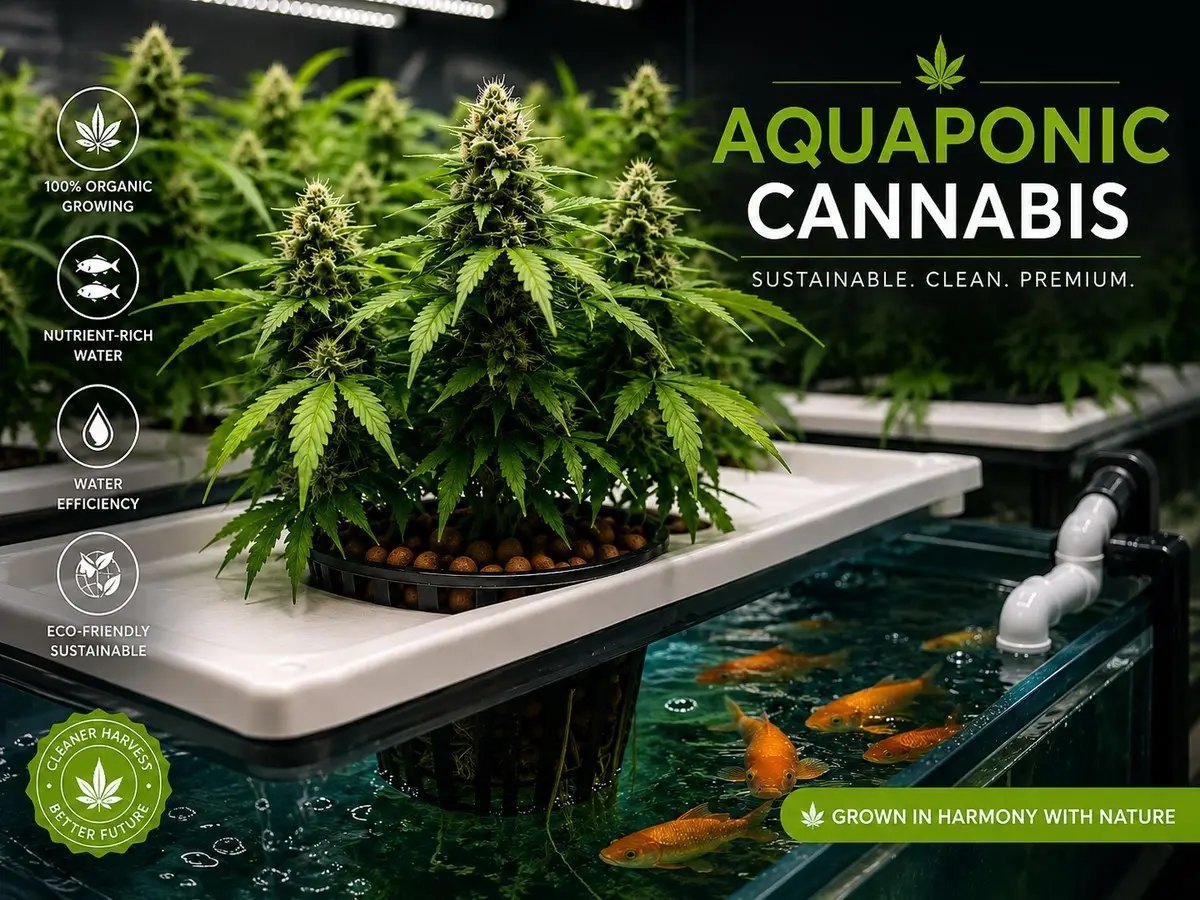
Fish Feed Is an Important Input in Aquaponic Hemp Cultivation
Fish feed is one of the least obvious inputs in clean hemp cultivation. In aquaponics, however, it helps determine what eventually reaches the crop.
Feed supplies much of the nitrogen and phosphorus entering the system. Its mineral content also affects water chemistry, solids accumulation, and biofilter demand. Poor quality ingredients may introduce excess copper or zinc, contaminated plant material, marine-sourced metals, mould, oxidised fats, or unverified additives.
For that reason, growers should record the manufacturer, product, ingredient list, lot number, mineral specifications, storage conditions, opening date, daily feeding rate, and any uneaten feed.
In mineral hydroponics, the fertiliser supplier largely controls the nutrient formula. In aquaponics, the fish feed supplier partly assumes that role.
Traceable records help identify a suspect feed batch, but they do not prove that the hemp is clean. Water and biomass testing must confirm that nutrients and contaminants remain within acceptable limits.
How Laboratory Testing Confirms Whether Hemp Products Are Cleaner
Aquaponics describes how hemp is grown. It does not certify the purity of the harvested flower or finished product.
Independent laboratory testing should verify cannabinoid potency and screen for pesticide residues, microbial contamination, mycotoxins, where relevant, and metals such as lead, cadmium, arsenic, and mercury. Extracts made with solvents also require residual solvent testing.
When reviewing a certificate of analysis, check for:
- A product name and matching batch number
- Sampling and testing dates
- The laboratory name
- Test methods and detection limits
- Pass or fail thresholds
- Individual cannabinoid results
- Complete contaminant panels
A report showing only CBD, THC, or other cannabinoid levels confirms potency. It does not show whether the batch was tested for pesticides, metals, microbes, mycotoxins, or solvents.
Aquaponic Hemp vs Other Hemp Cultivation Methods
Each cultivation method controls contamination, water, nutrients, and energy differently.
The table below compares their typical characteristics rather than promising the same outcome from every farm.
| Factor | Aquaponic hemp | Mineral hydroponics | Field-grown hemp | Living soil hemp |
|---|---|---|---|---|
| Exposure to field soil contaminants | Low | Low | Varies by site | Depends on the soil and amendments |
| Main nutrient source | Fish feed, water, microbes, and supplements | Prepared mineral solution | Soil, fertilisers, and amendments | Soil biology and organic amendments |
| Water reuse potential | High in recirculating systems | High in recirculating systems | Usually lower | Varies by irrigation design |
| Feed-related contamination route | Yes | No | No | No |
| Chemical pesticide options | Limited by fish and system biology | Broader, subject to crop rules | Broader, subject to crop rules | Often limited by production standards and grower choices |
| Nutrient control | Moderate to high, especially in decoupled systems | High | More variable | Moderate |
| Biological complexity | Very high | Lower | High | High |
| Input traceability potential | High with complete records | High with complete records | Varies by farm records | Depends on amendment and supplier records |
| Proof of product cleanliness | Laboratory testing | Laboratory testing | Laboratory testing | Laboratory testing |
Aquaponics offers stronger control over some contamination routes, while mineral hydroponics usually allows more precise nutrient adjustment. Field cultivation may require less facility energy, and living soil can support a richer soil ecosystem.
The quality of the resulting hemp still depends on how well each farm manages its particular risks
Cleaner Hemp Begins With a More Controlled Growing System
Aquaponics cannot remove every cultivation risk, but it can make those risks easier to identify and control.
It can reduce exposure to contaminated field soil, agricultural runoff, and routine pesticide spraying. It also gives growers a clearer record of source water, fish feed, supplements, indoor conditions, and nutrient movement through the system.
That control has limits. Metals may enter through feed or hardware. Poor humidity can encourage mould. Harvesting, drying, extraction, and handling can introduce new risks after cultivation ends.
Aquaponics, therefore, supports cleaner hemp by narrowing contamination routes and making inputs easier to trace. It cannot prove purity on its own.
The final answer comes from laboratory testing. Potency results and complete contaminant panels show whether tighter cultivation controls produced hemp that meets the expected quality and safety standards.
FAQs
Is aquaponic cannabis pesticide-free?
Not necessarily. Aquaponics can discourage chemical pesticide use because treatments may harm fish, beneficial organisms, or nitrifying bacteria. Growers may still use approved biological, botanical, or mineral pest controls. Those products can also leave residues, so a pesticide screening panel is needed to verify the finished batch.
Can aquaponic hemp contain heavy metals?
Yes. Removing field soil eliminates one possible exposure route, not every source of metals. Lead, cadmium, arsenic, mercury, copper, or zinc may enter through source water, fish feed, mineral supplements, dust, plumbing, or processing equipment. Aquaponics can make these inputs easier to trace, while testing confirms actual levels.
Does aquaponic cannabis use fish waste as fertiliser?
Fish waste contributes nutrients, but hemp roots do not simply absorb untreated waste. Fish release ammonia, which microorganisms convert into nitrite and then plant-available nitrate. Mechanical filtration removes solids, while mineralisation may recover additional nutrients from them. The plants receive processed nutrients through the water, not raw fish waste.
What is decoupled aquaponics cannabis cultivation?
A decoupled aquaponic system moves nutrient-rich water from the fish section into a plant section that can be managed more independently. Growers can adjust plant nutrients, pH, irrigation, or treatments without automatically returning every plant input to the fish. This provides more control than a single shared water loop.
Is aquaponic hemp organic?
Aquaponic hemp is not automatically organic. Certification depends on the country, certifying body, production system, and every input used, including feed, supplements, pest controls, and growing media. Some jurisdictions permit qualifying aquaponic crops to receive organic certification, while others apply different rules. Aquaponic, natural, and organic are not interchangeable terms.
Why does fish feed quality matter when growing aquaponic hemp?
Fish feed becomes an upstream crop input because nutrients released after digestion enter the plant production system. Its ingredients and mineral profile can affect nitrogen, phosphorus, trace elements, water chemistry, and solids. Contaminated ingredients, poor storage, or inconsistent batches may also introduce unwanted substances that later require water and biomass testing.
How can consumers verify the purity of an aquaponic hemp product?
Check a current certificate of analysis that matches the product batch or lot number. It should identify the laboratory, sample or test date, analytical methods, detection limits, cannabinoid results, and relevant contaminant panels. A potency-only report is incomplete because it does not confirm pesticide, metal, microbial, mycotoxin, or solvent testing.