







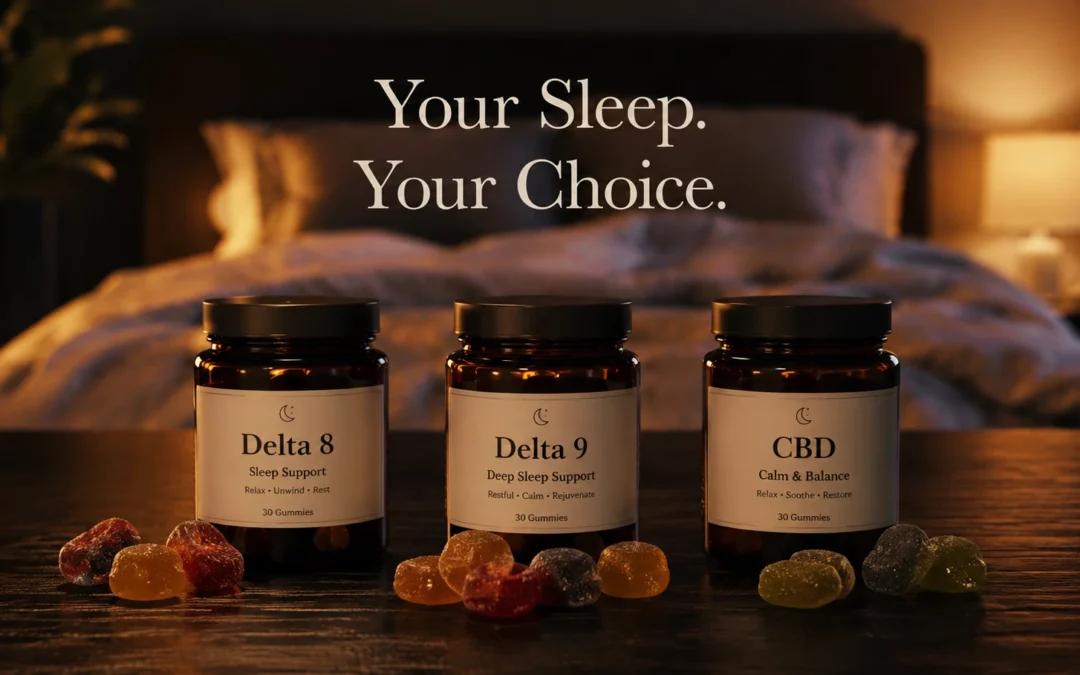
You take a gummy, turn off the lights, and expect sleep to follow. But the wrong choice could leave you wide awake, overly high, or foggy the next morning.
Delta 8, Delta 9, and CBD gummies may look similar on the shelf, but they do not offer the same bedtime experience. One may feel stronger, another may help you unwind without intoxication, while the third sits somewhere in between with more uncertainty around its effects.
So, which option actually suits your sleep goals?
The answer depends on what you want your nighttime gummy to do once your head hits the pillow.
Which Type of Gummy Is Best for Your Sleep Problem?
Best for Falling Asleep: Delta 9 or CBD?
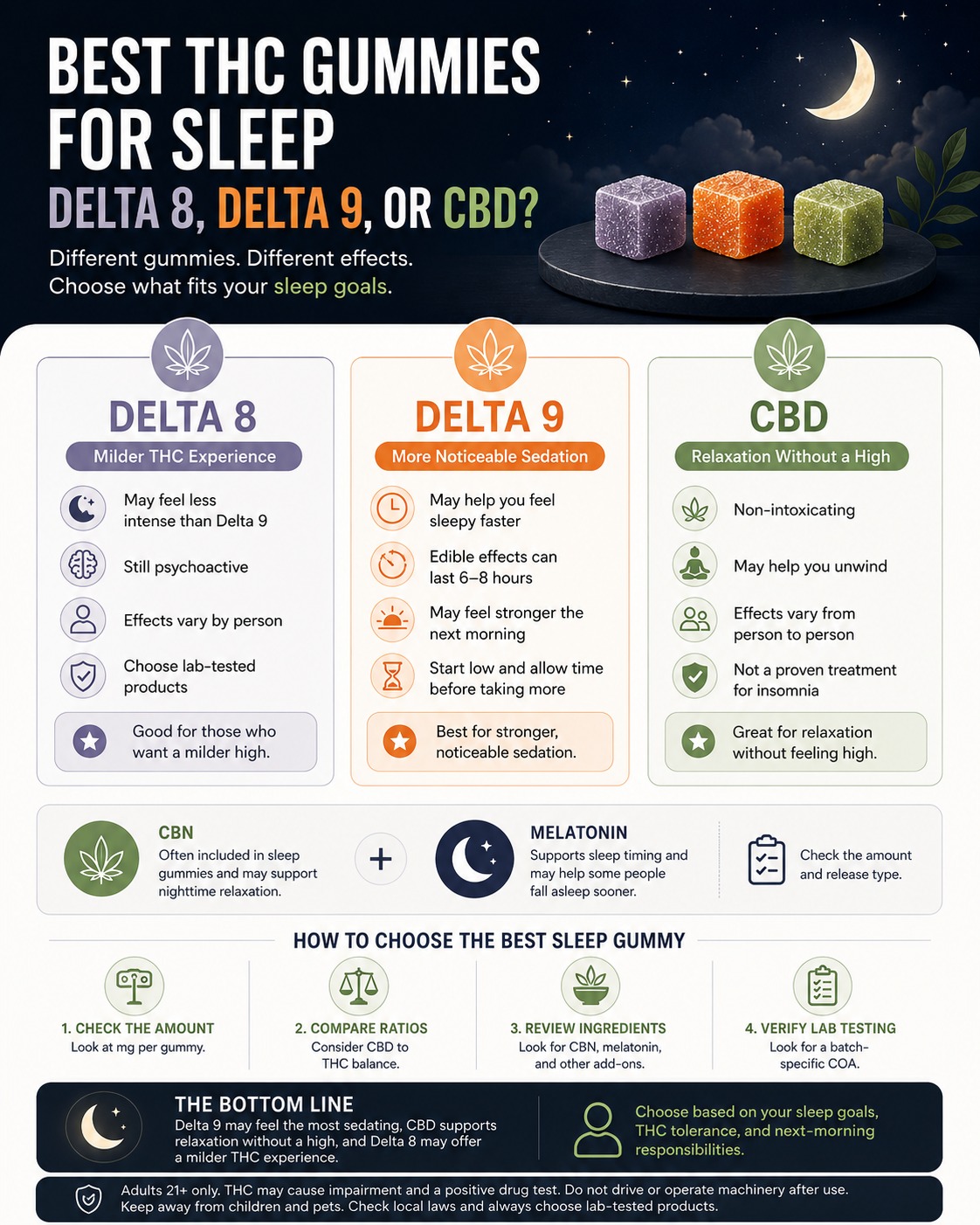
If falling asleep is your main concern, Delta 9 may create a more noticeable sleepy feeling. CBD may be more relevant when stress, tension, or racing thoughts prevent you from settling down.
Delta 9 can make some people feel drowsy, but its effects depend heavily on the amount taken and individual tolerance. Taking more does not guarantee faster sleep. Higher amounts of oral THC can increase anxiety, intoxication, and heart rate, which may leave you feeling restless or uncomfortable instead.
CBD works differently because it does not produce the same intoxicating high. It may help you unwind, particularly when anxiety or mental arousal is contributing to the problem. However, research on CBD and sleep remains inconsistent, so it should not be viewed as a reliable sedative.
Your choice may therefore depend on the experience you want:
- Consider Delta 9 when you want a stronger drowsy effect and are comfortable with intoxication.
- Consider CBD when relaxation is the priority, and you want to avoid feeling high.
- Use extra caution with higher THC amounts, especially if cannabis has previously caused anxiety or a racing heartbeat.
Finally, read the ingredient list. Some sleep support gummies contain melatonin, which can influence sleep timing separately from THC or CBD. This means the melatonin may be contributing to how quickly you fall asleep.
Best for Staying Asleep: THC and CBN Blends
If waking during the night is your main concern, a longer-lasting edible may seem more useful than inhaled cannabis. Oral THC takes longer to act, but its effects can continue for six to eight hours, which may help some users feel settled for more of the night. However, gummies have not been proven to prevent nighttime waking reliably.
CBN often appears in nighttime edibles because brands promote it as a sleep-focused cannabinoid. Early research offers some support, but the results are narrow.
One controlled trial found that 20 mg of CBN reduced nighttime awakenings and sleep disturbance, although it did not significantly improve overall sleep quality. Adding CBD did not strengthen the effect.
When comparing blends, check whether the gummy also contains:
- THC, which may provide much of the noticeable sedation
- Melatonin, which can affect sleep timing separately
- CBD or other calming ingredients
Longer effects can also carry into the morning, especially after a strong serving or late use. Research on measurable next-day impairment is mixed, but some users still report greater sleepiness.
A THC and CBN blend may suit you when staying asleep matters more than avoiding intoxication, but CBN should not be treated as a proven sleep aid.
Best for Relaxation Without a High: CBD Sleep Gummies
CBD sleep gummies may suit you when you want to unwind without the conventional high associated with THC. CBD is not intoxicating in the same way, so you are less likely to experience altered perception, euphoria, or the mental intensity that can accompany Delta 9.
However, CBD does not make everyone feel sleepy. Your response may vary based on the amount, formulation, other ingredients, and individual sensitivity. Some people describe a calmer evening, while others notice little change or feel more alert.
Research has not established CBD as a reliable treatment for insomnia, so it is better viewed as a possible relaxation aid than a direct sedative.
The type of CBD also affects what the gummy contains:
- CBD isolate: Contains CBD without other cannabinoids.
- Broad-spectrum CBD: Includes several hemp compounds but is generally formulated without THC.
- Full-spectrum CBD: Retains multiple cannabinoids and may contain a small amount of THC.
Check the laboratory report rather than relying only on the front label, especially when avoiding THC matters. Also, review added ingredients such as melatonin, since they may influence drowsiness independently.
CBD sleep gummies are generally the better fit when avoiding a high is your priority, but their calming and sleep effects are not predictable for everyone.
Best for a Milder THC Experience: Delta 8 Sleep Gummies?
Delta 8 sleep gummies may appeal to you when Delta 9 feels too intense. Users often describe Delta 8 as producing a gentler high, but that does not mean it is proven to be safer or better for sleep.
Research on Delta 8 remains limited, so there is not enough evidence to show that it reliably helps you fall asleep or stay asleep. It is also still intoxicating and may cause anxiety, dizziness, poor coordination, mental impairment, or lingering drowsiness the next morning.
Product quality deserves equal attention. Most commercial Delta 8 is made by converting CBD through chemical processing because hemp contains very little Delta 8 naturally. Poor manufacturing can leave unwanted byproducts or inaccurate cannabinoid levels in the finished gummy.
Therefore, choose only products with recent independent laboratory results confirming cannabinoid strength and screening for contaminants.
Delta 8 may provide a milder THC experience for some people, but it should not be treated as a proven middle option between Delta 9 and CBD.
Are Delta 9 Gummies Good for Sleep?
Delta 9 gummies may help some people relax and feel sleepy sooner, but stronger sedation does not always mean better quality sleep. Research remains mixed on whether THC improves total sleep time, sleep efficiency, or overnight waking.
Because edible THC can remain active for several hours, the effects may continue through much of the night. However, that longer duration may also leave you groggy, slow your reactions, or affect your judgement the following morning.
Repeated nightly use creates additional concerns. Over time, you may develop tolerance and notice less benefit from the same amount. THC may also alter REM sleep, although the effect varies across studies. Frequent users can experience temporary insomnia, vivid dreams, or disrupted sleep after stopping.
Delta 9 may not suit you if you:
- Are sensitive to THC or prone to anxiety
- Need to care for someone overnight
- Must respond quickly in an emergency
- Plan to drive or work early the next day
Overall, Delta 9 may provide short-term drowsiness, but it is not a dependable route to more restorative sleep.
Are Delta 8 Gummies Better for Sleep Than Delta 9?
There is not enough research to conclude that Delta 8 gummies work better for sleep than Delta 9. Delta 8 may feel less intense to some users, but it remains psychoactive and can still affect memory, coordination, judgment, and alertness.
The key differences are:
- Delta 9 has more sleep-related research, although the findings are mixed and do not prove that it consistently improves sleep quality.
- Delta 8 is often perceived as milder, but higher amounts can produce effects similar to Delta 9.
- Both can cause impairment and positive drug tests. Delta 8 metabolites strongly cross-react with common urine cannabinoid screening tests.
- Delta 8 carries added quality concerns because commercial products are commonly made by chemically converting CBD. Poor processing may leave contaminants or unwanted reaction byproducts.
Be cautious with claims such as “anxiety-free THC” or “the safest THC for sleep.” Some users report less anxiety with Delta 8, but reactions still vary, and serious adverse effects have been reported.
Delta 8 may feel gentler, but current evidence does not make it a better or safer sleep option.
Can CBD Gummies Help You Sleep?
CBD gummies may support sleep for some people, but CBD is not a conventional sleeping pill and does not reliably cause drowsiness.
Its potential benefit is often indirect. If stress, anxious thoughts, or physical discomfort make it difficult to relax, CBD may help you feel calmer before bed. However, responses differ, and current research does not show consistent improvements in insomnia symptoms.
A controlled trial using 150 mg of CBD found results similar to placebo for most sleep outcomes.
Retail products also vary widely in strength. A gummy containing a modest amount of CBD should not be expected to reproduce findings from studies using much larger daily doses.
Full-spectrum CBD requires additional caution because it may contain small amounts of THC. Regular use could therefore create drug testing concerns, even when the product does not cause a noticeable high.
Overall, CBD sleep gummies may help you unwind, but they are not a dependable treatment for insomnia.
What About CBN and Melatonin in Sleep Gummies?
CBN is often called the “sleepy cannabinoid,” but research is still limited. One small trial found that 20 mg of CBN reduced nighttime awakenings, although it did not improve every measure of sleep.
Many products combine CBN with THC, CBD, or melatonin, making it difficult to know which ingredient produced the effect. Melatonin works differently because it mainly supports circadian timing and may help some people fall asleep sooner.
Before choosing a formula, compare:
- CBN amount
- Melatonin amount
- THC and CBD ratio
- Immediate or extended-release melatonin
Immediate-release melatonin acts sooner, while extended-release versions maintain melatonin levels for longer. However, formulas containing several calming or intoxicating ingredients may increase morning tiredness.
Review the entire ingredient profile rather than assuming CBN alone will improve your sleep.
What About CBN and Melatonin in Sleep Gummies?
The best THC gummies for sleep are not necessarily the strongest. Compare the complete formula, serving amount, and laboratory results before deciding whether a product suits your sleep goals.
- Check the amount in each gummy: Read the quantity per individual gummy rather than relying on the package total. The label should clearly list Delta 8, Delta 9, CBD, and CBN amounts. Avoid vague descriptions such as “proprietary hemp blend,” which make it difficult to judge potency. Higher amounts may increase intoxication and side effects without improving sleep.
- Compare the CBD to THC ratio: THC-dominant formulas are more likely to cause a noticeable high. A CBD-dominant gummy containing a small amount of THC may feel more manageable for some users, while CBD-only products better suit those who want to avoid intoxication. However, CBD does not reliably cancel the cognitive or psychoactive effects of THC.
- Review additional sleep ingredients: Look for melatonin, CBN, L-theanine, chamomile, passionflower, and magnesium. These ingredients may affect how relaxed or sleepy you feel, but combining several calming compounds can also increase tiredness the next morning.
- Verify independent product testing: Look for a batch-specific certificate of analysis that matches the product name and lot number. Confirm that it reports cannabinoid potency and contaminant screening. Delta 8 products should also be tested for residual solvents and impurities created during conversion. A testing badge alone provides little reassurance when the full report is unavailable.
Delta 8, Delta 9, or CBD: Which Is Better for Sleep?
The better option depends on whether you prioritize stronger sedation, relaxation without intoxication, or a milder THC experience with added product quality concerns.
| Option | Choose It When | Main Limitation |
|---|---|---|
| Delta 9 gummies | You want the strongest noticeable sedation, accept intoxication, tolerate THC well, and can verify that the product has reliable laboratory testing. | Greater risk of anxiety, impaired judgement, and next morning grogginess. Stronger sedation does not guarantee better sleep quality. |
| CBD sleep gummies | Avoiding a high is your priority, or stress and difficulty relaxing contribute to poor sleep. You understand that CBD may support calmness without directly making you sleepy. | Sleep effects are inconsistent, and CBD should not be treated as a conventional sleeping aid. Full-spectrum products may contain THC. |
| Delta 8 sleep gummies | You are specifically seeking a potentially milder THC experience, and the product provides complete potency and contaminant results. | Sleep evidence is weak, effects remain intoxicating, and converted products may contain unwanted impurities when manufacturing controls are poor. |
Overall, Delta 9 generally provides the strongest short-term sedation, while CBD is better aligned with nonintoxicating relaxation. Delta 8 should not automatically be treated as the ideal middle option because its sleep evidence and manufacturing consistency remain weaker.
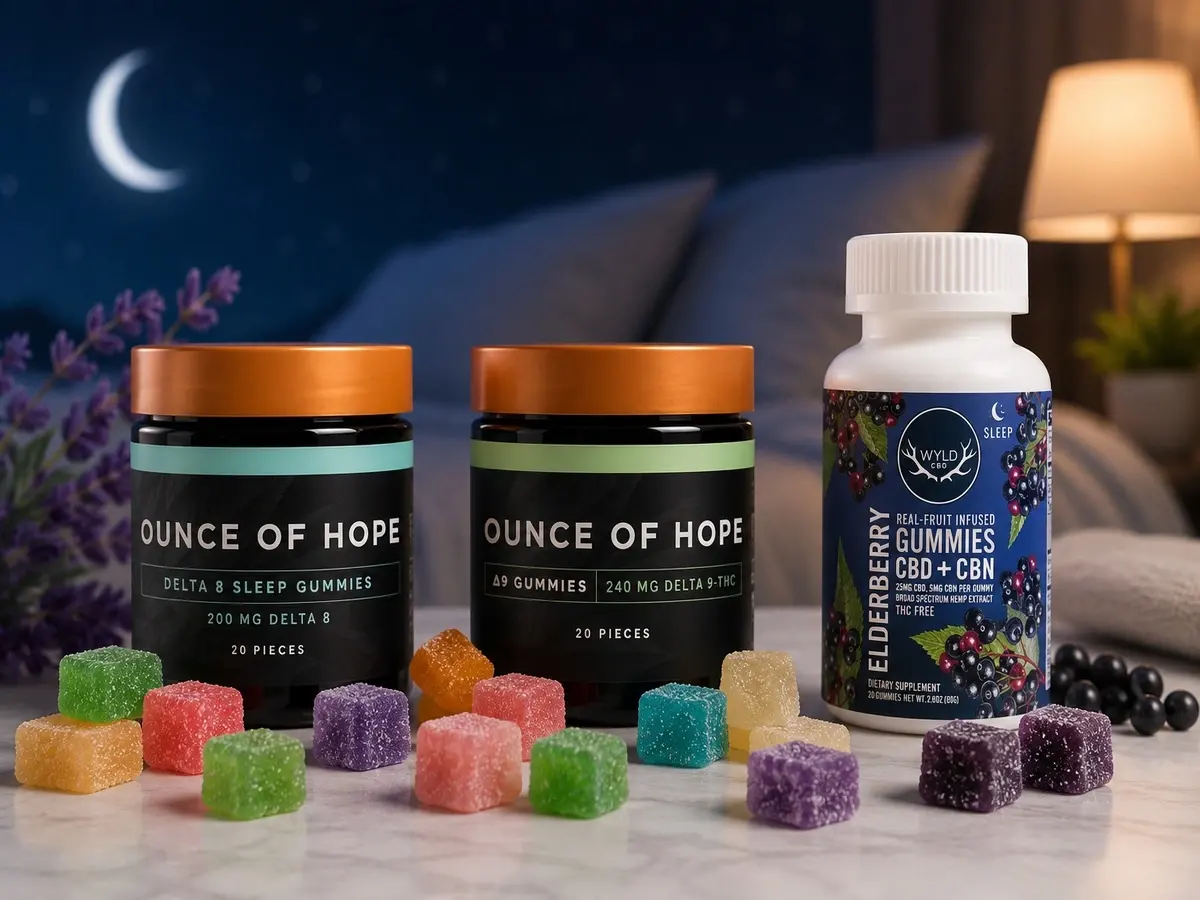
Better Sleep Starts With the Right Goal
Choosing a sleep gummy is less about finding the strongest formula and more about understanding what you need from it.
Delta 9 may create noticeable short-term drowsiness, but intoxication, tolerance, and next morning effects can outweigh that benefit. CBD offers a nonintoxicating option for relaxation, although it does not reliably make everyone sleepy. Delta 8 may feel gentler, but limited evidence and manufacturing concerns make broad claims about safety difficult to support.
Before buying, look beyond the front label. Compare the amount of each cannabinoid per gummy, the CBD to THC ratio, any added CBN or melatonin, and the batch-specific laboratory report.
The right choice should suit your sleep concerns, THC tolerance, and responsibilities the next morning. Feeling heavily sedated is not the same as getting better quality sleep.
FAQs
Is Delta 8 less likely to cause anxiety than Delta 9?
Some users describe Delta 8 as less intense and less likely to trigger anxiety than Delta 9. However, evidence mainly comes from surveys rather than strong clinical trials. Delta 8 can still cause anxiety, confusion, dizziness, and uncomfortable intoxication, especially at higher amounts or in sensitive users.
Are THC and CBN gummies good for staying asleep?
They may help some users feel settled for longer because edible THC can remain active for several hours. Early CBN research suggests a possible reduction in nighttime waking, but evidence remains limited. Since these gummies often combine THC, CBN, CBD, or melatonin, it is difficult to identify which ingredient caused the effect.
Can THC gummies make you groggy the next morning?
Yes. Oral THC can last for several hours, so a strong amount, late timing, or individual sensitivity may leave you sleepy or mentally foggy the next morning. Research on measurable next-day impairment is mixed, but you should avoid driving or performing safety-sensitive tasks until you feel fully alert.
Can Delta 8, Delta 9, or CBD gummies cause a failed drug test?
Delta 8 and Delta 9 can both produce positive cannabis test results. Pure CBD should not trigger a standard THC test, but full-spectrum or poorly labelled CBD gummies may contain enough THC to create a risk. Product labels cannot guarantee that you will pass an employment or roadside test.
Is it safe to use THC gummies every night?
Nightly THC use is not risk-free. Repeated use may increase tolerance, dependence risk, and the amount needed to feel the same effect. Frequent users may also experience temporary insomnia, vivid dreams, irritability, or anxiety after stopping. Speak with a qualified clinician if sleep problems persist or regular use becomes necessary.
How long before bed should you take a sleep gummy?
There is no universal timing because onset varies with the formula, serving amount, food intake, metabolism, and individual response. Follow the product label carefully. THC edibles may take 30 minutes to 2 hours to begin working and longer to reach full effect, so avoid taking another gummy too quickly.