







Start by checking how many milligrams (mg) of CBD are in a single gummy. Take one low-strength gummy, or even half, and chew it well. It's best to take it with food, then give it a couple of hours before you reach for another. If you're on any prescription medicine, check with your doctor first.
Those basics cover most of what you need. Still, no two people respond to CBD in quite the same way. Below, we'll explain how gummies work in your body, how to find an amount that suits you, and how CBD differs from THC. We'll also cover side effects, medications, drug tests, and the hemp law changes coming in 2026.
What Are CBD Gummies?
CBD gummies are chewable edibles made with a measured amount of cannabidiol (CBD), a compound found in hemp. On its own, CBD won't make you high. Every gummy contains a set number of milligrams, so you always know how much you're taking. That's a big reason gummies are so popular with people who are new to CBD edibles.
Full-Spectrum vs. Broad-Spectrum vs. CBD Isolate
The label should tell you which kind of extract is inside. There are three main types:
| Type | What it contains | Trace THC? |
| Full-spectrum CBD | CBD plus other cannabinoids, terpenes, and small amounts of THC | Yes |
| Broad-spectrum | Several plant compounds, with THC removed | Usually none, but not always zero |
| CBD isolate | Pure CBD only | No |
Full-spectrum CBD appeals to people who want more of the whole plant. Isolate suits people who want no THC at all. If you get drug tested at work, this choice matters a lot. We'll explain why further down. You can compare options on our CBD page.
CBD Gummies vs. THC Gummies: What's the Difference?
Put a CBD gummy and a THC gummy side by side and you probably couldn't tell them apart. Inside your body, though, they act very differently. They also call for very different dosing.
Do CBD Gummies Get You High?
No, CBD alone isn't intoxicating. People who notice an effect usually describe feeling calmer or more at ease. Plenty of people don't notice much at all.
Two things are worth knowing, though. Full-spectrum gummies carry trace amounts of THC. Some products also blend CBD with a real dose of THC on purpose. Before you assume a gummy is "just CBD," look for a THC number on the label.
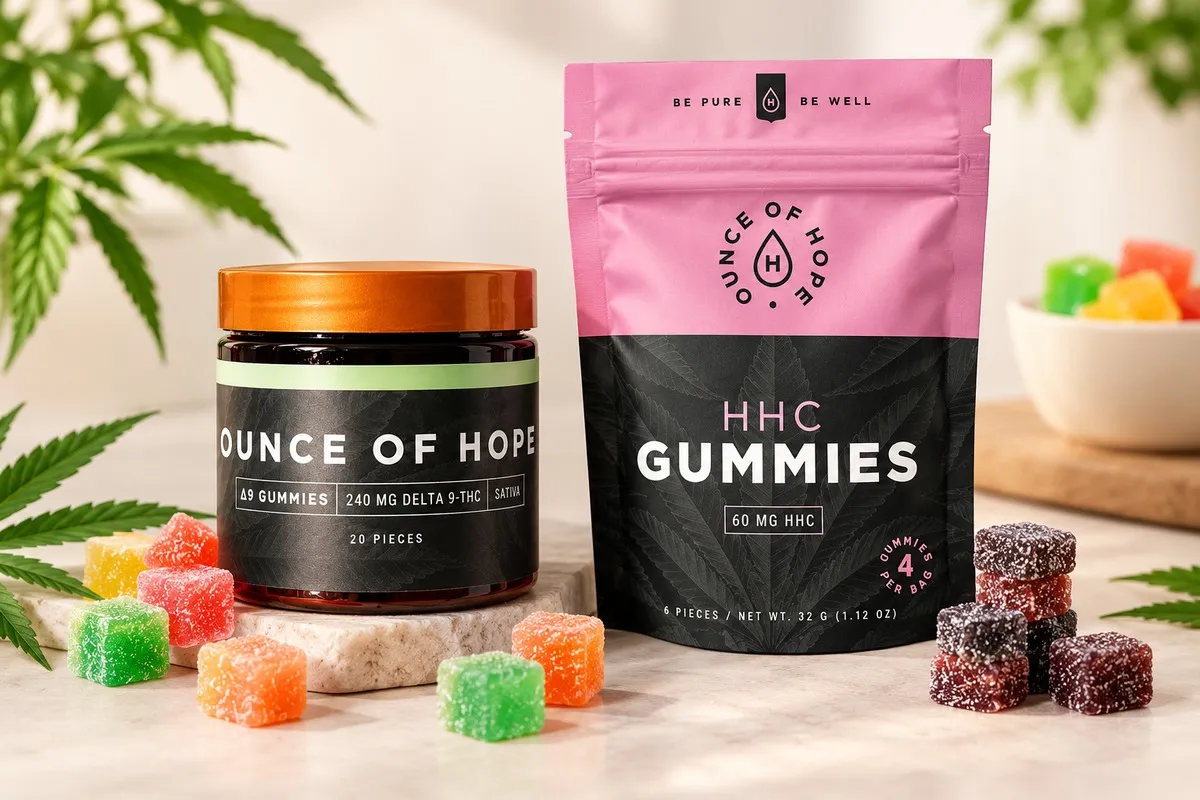
How Delta 8, Delta 9, HHC, and THCa Gummies Compare
| Compound | Intoxicating? | Key thing to know |
| CBD | No | Non-intoxicating, but can interact with medications |
| Delta 8 THC gummies | Yes | Often described as milder than Delta 9, but still impairing |
| Delta 9 gummies | Yes | Delta 9 THC is the main intoxicating compound in cannabis |
| HHC gummies | Yes | Less studied than Delta 8 or Delta 9 |
| THCa products | Yes, when heated | Can still show up on drug tests |
Here's the rule to remember: a THC gummy should never be dosed like a CBD gummy. Take a little too much CBD and you might feel sleepy. Take a little too much THC and you could be uncomfortable for the rest of the evening.
Want to dig deeper? Visit our Delta 8, Delta 9, HHC, and THCa pages, or read Does THCa Get You High?
How Do CBD Gummies Work in Your Body?
A gummy has to be digested before the CBD reaches your bloodstream. That longer route is why gummies take a while to kick in, and it's also why their effects tend to last.
Why CBD Edibles Take Longer Than Oils or Vapes
Once you swallow a gummy, your gut absorbs the CBD and sends it to your liver. The liver breaks down a good share of it before the rest moves into your blood.
So only a small part of the CBD listed on the label ever gets to work. A 2020 review in the journal CNS Drugs estimated that only about 6% of oral CBD is absorbed on an empty stomach. The same review found that absorption rose about fourfold when CBD was taken with a high-fat meal. The researchers noted these numbers aren't exact, but the lesson is simple. CBD dissolves in fat, so eating first helps your body take in more of it.
How Long Do CBD Gummies Take to Kick In, and How Long Do They Last?
Most people start to feel CBD gummies somewhere between 30 minutes and 2 hours after taking them. The effects often stick around for several hours.
What you eat, how fast your body processes things, and the strength of the gummy can all speed that up or slow it down. For more detail, see How Long Does It Take for Edibles to Hit?
How to Take CBD Gummies: A Step-by-Step Guide
Here's the simple process:
- Read the label to find the mg of CBD per gummy.
- Start with a low amount: one gummy or half.
- Chew it thoroughly, ideally with a meal.
- Take it at a consistent time of day.
- Wait at least two hours before taking more.
Step 1: Read the Label (mg per Gummy vs. mg per Package)
Beginners trip up here more than anywhere else. When a jar says "750 mg," that number is usually the total for the whole jar, not one piece. Say the jar holds 30 gummies. Then each gummy has 25 mg.
On the label, find:
- The serving size: how many gummies the brand counts as one serving
- The CBD per gummy: the number you'll actually dose by
- Any THC per gummy: even a small amount
- The batch or lot number: so you can match the product to its lab report
Step 2: Start With a Low Amount
With any cannabinoid, "start low, go slow" is the safest approach. If your gummies are fairly strong, cutting one in half is a smart first move.
Think of the serving size on the label as an upper limit, not a target. More can always come later. Once a dose is in your system, though, you can't take it back.
Step 3: Chew Thoroughly and Take It With Food
Don't swallow the gummy in chunks. Chew it all the way. Eating something with healthy fat, like eggs, avocado, or a handful of nuts, may help you absorb more CBD. A meal can also make the timing feel more predictable from one day to the next.
Step 4: Pick a Consistent Time
Morning or night is up to you. If CBD makes you drowsy, evenings might work better. If you feel normal after taking it, mornings are fine.
Sticking to the same time each day is what really helps, because it makes it much easier to notice how the gummy affects you.
Step 5: Wait Before Taking More
Bad edible experiences usually start with a second gummy taken too soon. THC products make this even riskier. Wait at least two hours after your first dose. Better yet, wait until the next day before you try a bigger amount.
How Much CBD Should You Take?
No single dose works for everyone. The FDA hasn't set a recommended amount for over-the-counter CBD. Most people start small, keep that amount for a few days, and make slow changes based on how they feel.
Factors That Change How CBD Affects You
Give the same gummy to two friends, and they may describe two different experiences. Here's why:
- Body size and metabolism: These shape how fast you process CBD.
- Food: A full stomach and an empty one can lead to very different results.
- Product type: Full-spectrum, broad-spectrum, and isolate don't always feel the same.
- How often you use it: Some people notice more with steady use.
- Other medicines and supplements: These can change how your body breaks down CBD.
- Liver health: Your liver handles most of the work of processing CBD.
- Your reason for taking it: Winding down at night isn't the same goal as staying calm at work.
How to Adjust Your Dose Safely
Only change one thing at a time. When you're ready for more, take a small step, like moving from half a gummy to a whole one. Then stick with that for several days.
Did something feel off? Go back to the last amount that worked well for you.
Track Your First Week
A quick daily note can save you a lot of guessing. Each day, write down:
- How much you took
- The time you took it
- Whether you'd eaten
- How you felt a few hours later
- How well you slept
By day seven, you'll start to see what works for you. The notes are also handy to bring to your doctor if questions come up.
How to Take 1:1 CBD and THC Gummies
In a 1:1 gummy, the CBD and THC amounts match, for example 5 mg of each. Base your dose on the THC, not the CBD. THC is the part that affects your thinking and coordination, so it should decide how much you take.
You might hear that CBD "balances out" THC. Research on that is mixed, so don't rely on it to prevent THC side effects.
In practice, treat any 1:1 product like a THC gummy:
- Start with a low dose and wait longer before taking more.
- Don't drive or operate machinery after taking it.
- Don't combine it with alcohol.
Our 1:1 Delta 8:CBD Gummies list both amounts on the label, so dosing by THC is easy.
Dos and Don'ts of Taking CBD Gummies
|
Do |
Don't |
|
Check the mg per gummy |
Assume the package total is one dose |
|
Start low and wait |
Take more before the first dose kicks in |
|
Check the lab report (COA) |
Buy gummies with no lab results |
|
Talk to your doctor if you take medicine |
Mix gummies with alcohol or sleep aids |
|
Store gummies locked and out of reach |
Keep them next to regular candy |
|
Take them at a consistent time |
Drive after taking THC-containing gummies |
When things go wrong, it's usually for one of two reasons: someone misread the label, or they didn't wait long enough. Avoid those two mistakes and you've taken care of most of the risk.
CBD Gummy Side Effects and What to Do About Them
CBD sits well with most people. Side effects can still happen, and they're more likely at higher amounts.
Common Side Effects
People have reported:
- Drowsiness or tiredness
- Upset stomach or diarrhea
- Changes in appetite
- Dry mouth
Most of these are mild, and they often fade if you take a bit less.
CBD and Liver Health
In clinical trials of Epidiolex, a prescription CBD medicine, some patients showed changes in their liver enzyme levels. Keep in mind those doses were much higher than what you'd get from a typical gummy. The FDA has also raised broader concerns about CBD and the liver.
That's one more reason to keep your dose reasonable. And if you have liver problems, talk to your doctor before trying CBD.
What to Do If You Took Too Much
A CBD-only gummy will most likely just leave you sleepy or with an unsettled stomach. Rest, drink some water, and let it wear off.
THC is a different story. Too much can make you anxious or dizzy, or make your heart race. Settle somewhere calm and comfortable, skip any more doses, and stay off the road. The feeling will ease with time.
Get medical help right away if someone has chest pain, trouble breathing, or severe confusion, or if a child has eaten gummies.
CBD Drug Interactions: Who Should Talk to a Doctor First?
If you read only one safety section in this guide, make it this one. CBD can change the way your body handles certain medicines.
How CBD Interacts With Medications
Your liver relies on a set of enzymes, called CYP450, to break down many common drugs. CBD can slow some of those enzymes. When that happens, a medicine may build up in your system and hit harder than expected.
An easy rule of thumb: does your medication come with a "grapefruit warning"? If so, ask your doctor or pharmacist before trying CBD. Grapefruit affects many of the same enzymes.
Medications to Ask About
The list below gives examples. It isn't complete:
- Blood thinners, such as warfarin
- Certain seizure medicines, such as clobazam
- Sedatives, sleep aids, and anxiety medicines
- Some antidepressants
- Some heart and blood pressure medicines
On any regular prescription? A two-minute call to your pharmacist is well worth it.
Who Should Avoid CBD Gummies
Hold off on CBD gummies, or get a doctor's okay first, if you:
- Are pregnant or breastfeeding
- Are under 21
- Have liver disease
- Have surgery coming up
Can CBD Gummies Make You Fail a Drug Test?
It's possible. Standard drug tests look for THC, not CBD. The problem is that full-spectrum CBD gummies contain small traces of THC, and with regular use those traces can build up. Mislabeled products raise the risk further, since some gummies contain more THC than the label admits.
How to Lower Your Risk
- Choose CBD isolate or a broad-spectrum product whose lab report shows no detectable THC.
- Check the THC line on the COA before you buy.
- If your job depends on passing drug tests, think it through carefully before using any cannabinoid product. No brand can promise you'll pass.
Related reading: Does THCa Show Up on a Drug Test? and How Long Do Delta 9 Gummies Stay in Your System?
2026 Hemp Law Changes: What They Mean for Gummy Shoppers
Big changes to federal hemp rules are coming in late 2026. Here's a plain-English summary as of this article's update date.
What's Changing at the Federal Level
In November 2025, a new law changed the legal definition of hemp. Instead of measuring only delta-9 THC, it measures total THC. It also caps finished products at 0.4 mg of THC per container, and it removes synthetic and lab-converted cannabinoids from the hemp definition.
The dates have shifted since then. Cannabinoids that can't be naturally produced by the plant lose hemp status on November 12, 2026. The 0.4 mg cap and the other changes kick in on December 11, 2026.
What It Means for CBD Gummies vs. THC Gummies
CBD products that stay under 0.4 mg of total THC per container are still legal. Most delta 8 THC gummies, delta 9 gummies, HHC gummies, and THCa products contain far more THC than that, so federally they would no longer count as hemp.
State laws add another layer. Some states already have their own limits, and those rules vary a lot.
How to Stay Informed
Things could still change before or after these deadlines. Before you order, check your state's current laws and your retailer's shipping restrictions. We'll update this section as the rules take effect.
How to Store CBD Gummies Safely Around Kids and Pets
To a child or a curious dog, a gummy looks like candy. Safe storage is one of the most useful safety steps you can take.
Safe Storage Habits
- Keep gummies in the original child-resistant package.
- Put them up high or in a locked box, well away from regular snacks.
- Store them somewhere cool and dry, out of direct sunlight. This also keeps them fresh and consistent.
Wondering how long they last? Read Do THC Gummies Expire?
If a Child or Pet Eats Gummies
If a child eats gummies, call Poison Control at 1-800-222-1222 right away. Call 911 if they're very drowsy, have trouble breathing, or won't wake up.
If a pet eats gummies, call your vet or the ASPCA Animal Poison Control Center at (888) 426-4435. THC is especially risky for dogs. Some gummies are also sweetened with xylitol, which is toxic to dogs.
Human gummies aren't meant for pets. If you'd like to try CBD for your pet, look for products made for animals, like those in our CBD for Pets collection. Check with your vet first.
How to Choose Quality CBD Gummies
CBD isn't tightly regulated, so quality can vary a lot from brand to brand. Your best protection is a company that shows you exactly what's in each batch.
What to Look for on a Certificate of Analysis (COA)
A COA is a lab report from an independent, third-party lab. A good one should:
- Have a batch number that matches your product
- Show CBD and THC amounts close to what the label says
- Include screens for heavy metals, pesticides, leftover solvents, and microbes
- Be recent, not years old
At Ounce of Hope, we grow our hemp on our own aquaponic farm and make our products in-house. Every batch goes to a third-party lab, and we post the results on our Lab Results page so you can see them for yourself.
Red Flags to Avoid
- No lab report, or one you can't match to your product
- Claims that the gummy "cures" or "treats" a disease
- Vague labels like "hemp extract" with no mg listed
- High-strength gummies at prices that seem too good to be true
Common Myths About CBD Gummies
"More CBD always works better." Not really. Taking more mostly raises your odds of side effects. Plenty of people do well with modest amounts.
"All CBD gummies are THC-free." Full-spectrum gummies contain trace THC, and some products contain much more. The label and COA will tell you.
"Natural means no side effects." CBD can still cause drowsiness or an upset stomach. It can also interact with medications.
"You'll feel it in minutes." Gummies usually take 30 minutes to 2 hours. Getting impatient is how people end up taking too much.
"CBD and THC gummies are dosed the same way." They aren't. THC gummies need far more caution.
Your Safe Start With CBD Gummies
Taking CBD gummies safely comes down to a few habits:
- Know how much CBD is in each gummy.
- Start small and give it time to work.
- Take it at the same time each day, ideally with food.
- Talk to your doctor if you take medication.
- Choose products with clear, up-to-date lab results.
Everyone's body is a little different, so be patient with yourself. Pay attention to how you feel, and make changes slowly.
To keep learning, browse our Edibles or visit our FAQs page.
These statements have not been evaluated by the FDA. This product is not intended to diagnose, treat, cure, or prevent any disease. For adults 21+ only. Consult your physician before use if you are pregnant, nursing, have a medical condition, or take prescription medication.
Frequently Asked Questions
How many CBD gummies should I take as a beginner?
Start with one low-strength gummy, or half of a stronger one. Stay at that amount for a few days before you increase it. Strengths vary a lot between brands, so always check the mg per gummy.
Should I take CBD gummies in the morning or at night?
Either is fine. If CBD makes you sleepy, evenings may work better. Whatever time you pick, keep it the same each day so you can tell how the gummy affects you.
How long do CBD gummies stay in your system?
That depends on your dose, how often you take it, and your metabolism. People who use CBD now and then clear it faster than daily users. If a drug test is your worry, the THC in full-spectrum products matters more than the CBD.
Do CBD gummies expire?
Yes. Look for the date on the package. If you store them somewhere cool and dry, they'll hold their strength longer.
Is it okay to mix CBD gummies with alcohol?
It's best not to. Both can make you drowsy, and together the effect may be stronger. Never mix alcohol with gummies that contain THC.