


If you have ever stared at a jar labeled "29% THCa" and wondered whether that means you are about to get very high or feel nothing at all, you are asking the right question.
Here is the short version. THCa on its own does not get you high. Heat it, and it does. That single fact explains almost everything confusing about THCa flower, THCa vapes, and the numbers printed on the label.
The rest of this article covers the part most people actually need: why heat matters so much, why the percentage on the jar is not the percentage you feel, and why two people can smoke the exact same flower and walk away with completely different stories.
The Short Answer: Heat Decides Everything
THCa is a compound found in raw cannabis. In its raw, unheated state, it is not intoxicating. You could eat a fresh bud and you would not feel high.
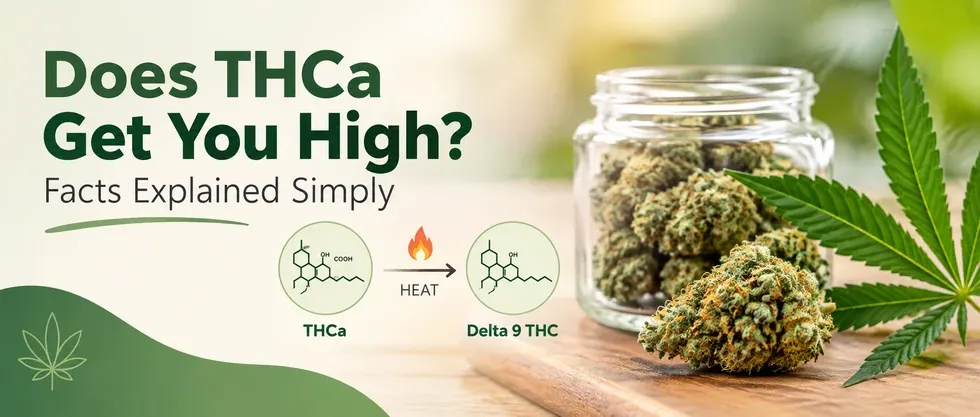
Apply heat, though, and THCa changes into Delta 9 THC. Delta 9 is the compound most people mean when they say "high." So when you light a bowl, hit a vape, or bake flower into butter, you are not really consuming THCa anymore. You are consuming what THCa becomes.
That is why the honest answer to "does THCa get you high" is: not by itself, but almost every way people actually use it turns it into something that does.
What THCa Actually Is
THCa stands for tetrahydrocannabinolic acid. It is the form the cannabis plant naturally produces.
Why the Plant Makes THCa Instead of THC
Living cannabis plants do not really make THC. They make acid forms of cannabinoids, and THCa is the most abundant one in high-potency varieties. The same thing happens with CBD, which starts out in the plant as CBDa.
Those acid forms sit in the sticky resin glands on the flower. As the plant is harvested, dried, and cured, a small amount converts on its own. Most of it stays as THCa until something heats it.
One Small Difference, One Big Effect
Chemically, THCa is Delta 9 THC with one extra piece attached: a carboxyl group. That extra piece is small, but it changes how the molecule behaves in your body.
THC slips easily into the brain and binds tightly to receptors called CB1 receptors, which is where the high comes from. THCa, with its extra attachment, is more awkwardly shaped and more difficult for the body to move into the brain.
Why Raw THCa Does Not Make You Feel High
Lab research has compared how strongly THCa and THC grip those CB1 receptors. THC binds many times more strongly. Work from researchers at the University of Auckland found THC's binding strength at CB1 was dozens of times greater than THCa's, with an even wider gap at CB2 receptors.
Put simply, THCa barely gets a grip. It also does not cross into the brain as readily as neutral cannabinoids like THC and CBD do, because acid forms move through the body differently.
This is why people who juice raw cannabis leaves or steep fresh flower in tea report no intoxication. Some people are interested in raw cannabinoids for other reasons, and early research is looking at what THCa may do in the body on its own. That research is still in its early stages, and nothing here should be read as a health claim.
The practical takeaway stands on firmer ground: raw means not high, and heated means something else entirely.
How Heat Turns THCa Into Delta 9 THC
The process has a long name, decarboxylation, but the idea is simple.
Decarboxylation Without the Chemistry Lecture
Heat weakens the bond holding that extra carboxyl group in place. The group breaks off and escapes as carbon dioxide gas. What remains is Delta 9 THC.
Two things drive this: temperature and time. Higher heat works faster. Lower heat works slower but is gentler on flavor compounds. When people decarb flower in an oven for edibles, they usually work in a moderate range for roughly half an hour or more, though exact times and temperatures vary by recipe and equipment.
Combustion is a different story. When a flame touches flower, temperatures are far higher, and conversion happens essentially the moment you light it.
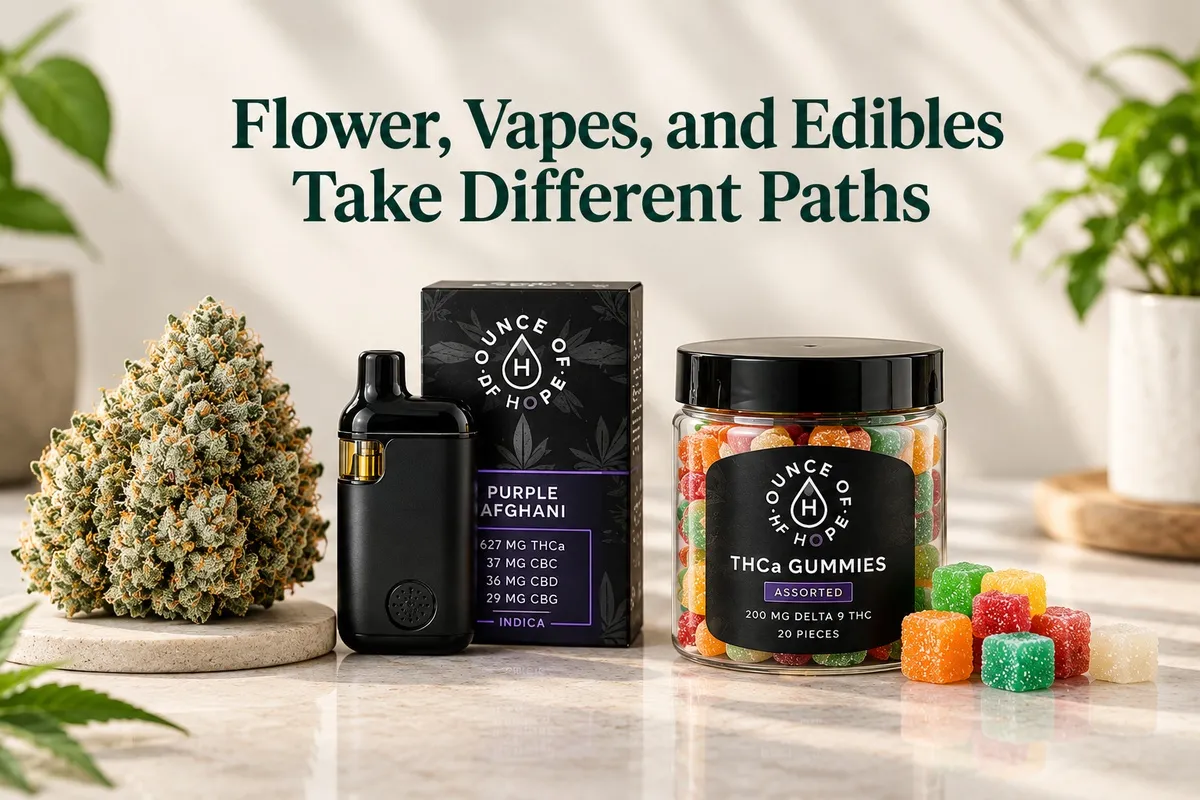
Flower, Vapes, and Edibles Take Different Paths
Smoking THCa flower converts it almost instantly through the heat of burning. There is no waiting and no prep.
A THCa vape uses a controlled heating element instead of open flame. Temperatures are lower than combustion but still high enough to convert the THCa as you draw.
THCa edibles are where confusion creeps in. Your stomach does not reliably decarboxylate THCa. If a product is meant to be felt, the conversion has to happen during manufacturing, before it ever reaches the package. A reputable maker will have handled that and the lab report will show it. A product sold as truly raw THCa, with no heating step, is a different thing altogether.
Concentrates follow the same rule. A THCa concentrate meant for dabbing converts the moment it hits a hot surface.
Why "30% THCa" Is Not "30% THC"
This is the single most common source of disappointment, and it is worth understanding before you buy anything.
The Math Labs Use
When THCa loses that carboxyl group, it also loses a bit of weight. Roughly 87.7% of the original THCa weight carries over as THC. Labs account for this with a standard calculation: multiply the THCa figure by 0.877, then add any Delta 9 THC already present. The result is called total THC.
So flower testing at 30% THCa has a theoretical ceiling somewhere around 26% THC, before anything else happens.
What Gets Lost Between the Flame and Your Lungs
That ceiling is theoretical. In real use, more is lost.
Some THC burns away completely at combustion temperatures. Some drifts off as side smoke between puffs. Some condenses on the glass or in bong water. Studies using smoking machines have found that only a portion of the theoretically available THC actually ends up in the smoke, and the results ranged widely between samples and methods.
None of this means high-THCa flower is weak. It means the number on the jar describes the raw material, not the dose you receive. That is why comparing two products by label percentage alone is a poor way to predict how they will feel.
Why the Same Flower Hit Two People Differently
You and a friend share the same jar, the same strain, the same session. One of you feels pleasantly relaxed. The other feels far more than they wanted. Neither of you did anything wrong.
Effects vary, and they vary a lot. Here is what moves the needle.
Tolerance is the biggest factor. Someone who uses cannabis regularly has a different baseline than someone who has not touched it in a year. Regular use changes how the body responds over time, and two people at different points on that curve can have very different sessions from identical material.
How much actually converted matters. A joint, a bowl, a bong, and a vape at a set temperature do not deliver the same amount of THC from the same gram. Device temperature, how deeply you inhale, how long you hold it, and even how the flower was packed all shift the outcome.
Body chemistry is individual. Metabolism, body composition, liver enzyme activity, and genetics all influence how THC is processed and how long it sticks around. This is why dose guidance is always a starting point rather than a prescription.
What is in your stomach changes edibles dramatically. An edible on an empty stomach often feels different from the same edible after a full meal. Onset timing with edibles is slower and far less predictable than inhalation, and that unpredictability is where most uncomfortable experiences come from.
The rest of the plant plays a role. Flower is not just one compound. Terpenes and other cannabinoids differ from batch to batch, even within the same strain name, and the overall profile can shape whether a session feels alert or sleepy.
Context is real, not imaginary. Sleep, hydration, food, stress, mood, whether you are somewhere comfortable, and what you are expecting to feel all influence the experience. This is well documented for cannabis generally and applies just as much here.
Medications and health conditions matter. Some prescriptions interact with cannabinoids. If you take medication regularly or have a heart, liver, or mental health condition, that is a conversation to have with a doctor rather than a forum.
The honest conclusion is that nobody can promise you a specific feeling from a specific product. What you can control is how you start.
THCa and Drug Testing
This is where a lot of people get caught out.
Standard drug tests do not look for THCa. They look for a metabolite the body produces after processing Delta 9 THC. Since heating THCa produces Delta 9 THC, using THCa flower or vapes will very likely produce that metabolite.
The "it was only THCa" argument does not hold up on a test result. There is no screening panel in common use that distinguishes hemp-derived Delta 9 from any other Delta 9.
Detection windows also vary widely between people. Frequency of use, body composition, metabolism, hydration, and the sensitivity of the specific test all affect how long something remains detectable. Ranges published online should be treated as rough and nothing more. If you face testing for work, safety-sensitive duties, or legal reasons, the only reliable approach is to not use these products
Misconceptions Worth Clearing Up
"THCa is legal, so it must be mild." Legal status and strength are unrelated. Once heated, high-THCa hemp flower behaves like the cannabis it chemically is.
"THCa flower is fake weed." It is the same plant and the same primary compound. The difference is which number the law measures, not what is growing in the field.
"Raw THCa edibles will still get me high." Only if they were decarboxylated during production. Digestion alone is not a reliable substitute for heat.
"THCa won't show up on a test." Covered above. It very likely will.
"A higher THCa percentage always means a better experience." Potency is one variable among many, and for newer users a lower-potency option is often the more enjoyable choice. If you are not sure, milder categories like CBD or measured Delta 9 edibles give you far more control over the dose.
Where THCa Stands Legally Right Now
This part is genuinely in motion, so treat the date attached to it as important. As of September 2026, here is the picture.
The 2018 Farm Bill defined hemp using Delta 9 THC alone, at no more than 0.3% by dry weight. Because THCa is not Delta 9, high-THCa hemp flower fit inside that definition, and that is what created the national THCa market.
In November 2025, Congress changed the definition. A provision in the FY2026 agriculture appropriations law shifts hemp to a total THC standard that explicitly counts THCa in the calculation, and adds a strict per-container limit on total THC in finished products. That change was written with a one-year runway.
A short-term funding bill signed in early September 2026 moved most of that effective date back by about a month, to December 11, 2026, for cannabinoids the plant produces naturally. Products built on cannabinoids the plant cannot naturally produce were not given that extension.
Several bills have been introduced that would delay, soften, or replace the standard. Nothing is settled.
State law sits on top of all this and is not uniform. Some states moved to total THC standards on their own timelines, and some restrict these products outright. That is why shipping rules differ by destination. Before ordering, check our shipping policy and your own state's current rules.
Practical Safety and Storage Notes
Start low and give it time. With inhalation, take one draw and wait several minutes before deciding on more. With edibles, wait considerably longer. Most bad experiences come from redosing too early.
Heat and time will convert THCa whether you meant it or not. A jar left in a hot car, a sunny windowsill, or a warm cabinet slowly converts on its own. Over longer periods, THC itself also breaks down into other compounds, which is part of why older flower often feels more sedating. Store products cool, dark, and sealed.
Do not drive or operate machinery. Impairment is real even when the legal category is not marijuana.
Some people should skip it entirely. Anyone under 21, anyone pregnant or nursing, and anyone whose doctor has advised against cannabinoids. If you take prescription medication or have a heart or mental health condition, talk to a healthcare provider first.
If a session gets uncomfortable, it passes. Find a quiet space, drink water, sit down, and wait it out. Effects from inhalation fade faster than effects from edibles.
How to Check a Product Before You Buy
A certificate of analysis, or COA, is the receipt for what is actually in the jar. Look for a few things.
Check that the COA matches the batch you are buying, not a generic sample from months earlier. Look at both the THCa figure and the Delta 9 figure, and note the total THC calculation. Check that the panel covers more than potency, including pesticides, heavy metals, microbials, and residual solvents where relevant. Check the date.
You can review our published results on the lab results page, and browse the full THCa selection if you want to compare specific batches. More general questions are answered on our FAQ page.
The Bottom Line
THCa will not get you high in its raw state. Heat it, and it becomes Delta 9 THC, which will. Since nearly every common way of using THCa involves heat, most people asking this question should plan on real intoxicating effects.
How strong those effects feel depends on you: your tolerance, your method, your body, your dose, and the day you are having. Start small, read the lab report, know your state's rules, and give the product time to tell you what it does.
FAQs
1. Does THCa get you high if you eat it raw?
No. In its raw, unheated form THCa does not produce intoxicating effects. It binds very weakly to the brain receptors responsible for the cannabis high and does not cross into the brain as readily as THC does. Effects change completely once heat is applied.
2. Is smoking THCa the same as smoking regular cannabis?
Functionally, yes. The heat of combustion converts THCa into Delta 9 THC almost instantly, so the experience is comparable to cannabis with a similar total THC figure. The main difference is how the product is classified and measured under the law, not what happens in your lungs.
4. Will THCa show up on a drug test?
Very likely, if you heat it. Drug tests look for a metabolite the body produces after processing Delta 9 THC, and heated THCa produces Delta 9 THC. There is no common test that separates hemp-derived Delta 9 from any other source. Detection windows vary widely from person to person.
5. How long do the effects last?
It depends on the method and the person. Inhaled effects generally come on quickly and fade sooner. Edibles take longer to begin and tend to last considerably longer. Tolerance, dose, metabolism, and whether you have eaten all shift the timing, so treat any published range as a rough guide rather than a rule.
6. Do THCa edibles work the same way as THCa flower?
Not automatically. Digestion does not reliably convert THCa the way heat does, so an edible needs to be decarboxylated during production to be felt. Check the product's lab report to see what form the cannabinoids are actually in.
7. Is THCa still legal?
As of September 2026, high-THCa hemp products remain federally saleable under the framework created by the 2018 Farm Bill, but a change to the federal definition of hemp is scheduled to take effect in December 2026. That change would measure total THC including THCa. State laws differ and some are stricter. Check current federal status and your own state's rules before ordering.